
How to Phrase Match Your Mixes Using 8 and 16 Bar Counting
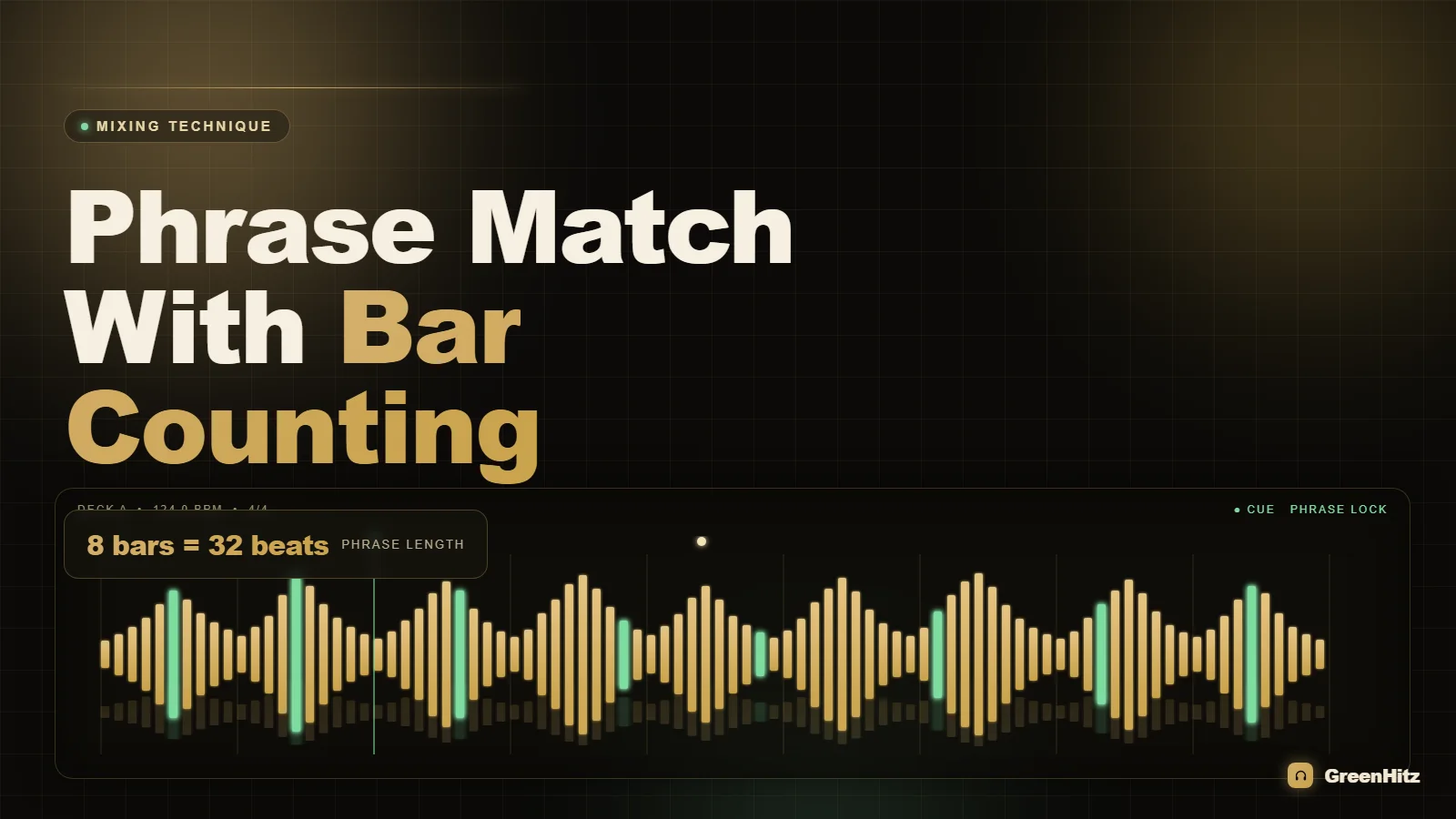
To phrase match your mixes, count music in groups of 8 and 16 bars and always start your incoming track at the beginning of a phrase so its energy changes line up with the outgoing track. A bar is 4 beats, a standard dance phrase is 8 bars (32 beats), and most builds, breakdowns and drops arrive in blocks of 16 or 32 bars. Match those blocks and your transitions land on the one instead of colliding in the middle of a section.
Beatmatching keeps two records in time. Phrase matching keeps them in agreement. You can have a perfect tempo blend that still sounds wrong because the incoming kick pattern is fighting the outgoing snare fill, or the vocal enters two bars before the drop and steps on it. Once you learn to count phrases, that guesswork disappears and every mix feels like the tracks were built to go together.
What a Bar and a Phrase Actually Are
Almost all club music (house, techno, tech house, hip hop, Afrobeats, drum and bass) is written in 4/4 time. That means 4 beats per bar. The kick usually lands on every beat in four-on-the-floor genres, so one bar equals four kicks.
Producers build songs out of grouped bars, and the ear expects those groups in powers of two:
- 1 bar = 4 beats
- 4 bars = 16 beats (a short building block)
- 8 bars = 32 beats (one standard phrase)
- 16 bars = 64 beats (a full section: intro, breakdown, drop)
- 32 bars = 128 beats (a big movement in longer tracks)
The magic number is 8. Nearly every important event in a track (a new element entering, a filter opening, a snare roll, the drop) happens on the downbeat of an 8 or 16 bar boundary. If you can feel where those boundaries are, you can predict what the music is about to do before it does it.
Why 8 and 16 Matter More Than the Others
You count in 8s because that is the smallest phrase your brain naturally hears as a complete musical thought. You think in 16s because that is how sections are structured. A house intro is often 16 or 32 bars of drums. A breakdown is usually 16 bars. The build into a drop is frequently the last 8 or 16 bars of a section. Learn to hear both the small phrase and the big section and you always know how much runway you have left.
How to Count Bars While a Track Is Playing
Here is the counting method that working DJs use. Instead of counting every beat (1, 2, 3, 4 over and over), you count the bar number on the first beat of each bar.
- Find beat one. This is usually the loudest kick, the one where the loop feels like it restarts. If there is a vocal or melodic phrase, it typically begins here too.
- On each new bar, say the bar number: 1-2-3-4, 2-2-3-4, 3-2-3-4, up to 8-2-3-4.
- When you hit 8, that phrase is complete. Start again at 1 for the next phrase.
- To track 16 bar sections, count two phrases: one full 8 count is the first half, the second 8 count is the second half.
Do this out loud at home until it becomes silent and automatic. The tell that you are counting right: when you land on bar 8 or bar 16, something in the music changes. A hat pattern shifts, a new synth enters, the snare rolls. If nothing changes on your 8s, you started your count on the wrong beat. Slide it over and try again.
Reading Waveforms and Beat Grids as a Shortcut
On CDJs, the DDJ series and Serato or Rekordbox, the beat grid gives you visual bar markers, and many platforms show phrase markers or downbeat lines. Use them as training wheels, not a crutch. The waveform tells the same story your ears do: you can see the breakdown thin out, the build ramp up, and the drop hit as a wall of low end. If you are dialing in a controller workflow, our guide to preparing and playing tracks on the DDJ FLX4 walks through setting grids and cues so your phrase counting is backed up by clean visual reference points.
The 8 and 16 Bar Phrase Matching Method, Step by Step
Now put counting to work in an actual transition. The goal is to have both tracks hit their phrase boundaries at the same moment so the switch feels planned.
- Beatmatch first. Get the tempos locked and the kicks aligned. Phrase matching sits on top of beatmatching, not instead of it.
- Count the outgoing track. Know where you are in its current phrase. If the drop just hit, you likely have 16 or 32 bars before the next natural exit point.
- Plan your exit. Decide where the outgoing track should hand off. The cleanest spots are the start of a breakdown or the last 8 bars of a section before it changes.
- Cue the incoming track to a phrase start. Set your play point on beat one of an intro phrase or a drum section, not somewhere random in the middle.
- Bring it in on the one. Release the incoming track so its bar 1 lines up with a bar 1 (or a bar 1 of a fresh 8 or 16) on the outgoing track.
- Ride the phrase. Blend across 8, 16 or 32 bars using your EQs and faders, then let the incoming track take over as the outgoing track ends a phrase.
The single most common mistake is bringing the new track in one, two or three bars off. It still beatmatches, but the snares and builds are misaligned and the mix feels seasick. Count first, then let go.
Where to Start and Where to Exit
Different sections give you different mixing options. Here is a quick map of what each phrase block is good for.
| Section | Typical length | Best use in a mix |
|---|---|---|
| Intro (drums only) | 16 to 32 bars | Bring the incoming track in here, layer over the outgoing groove |
| Breakdown | 16 bars | Great exit point for the outgoing track, energy dips naturally |
| Build | 8 to 16 bars | Tension zone, keep both tracks tight, do not clash vocals |
| Drop / main groove | 16 to 32 bars | Full energy, hand off the low end cleanly with the bass EQ |
| Outro (drums only) | 16 to 32 bars | Long runway to mix the next track over the top |
A reliable move: start the incoming track's intro on the outgoing track's breakdown. The two thin sections overlap without a bass clash, then both hit their builds and drops together for a huge lift. That only works if you counted the phrase so the two builds line up on the same bar.
Handling Tracks That Break the 8 Bar Rule
Not everything is a tidy 32 bar house track. Hip hop, older disco, live-recorded edits and open format bangers throw curveballs: odd intros, extra bars, half-phrase turnarounds. This is where record pool prep pays off. Clean, DJ-ready versions with proper intros and consistent structures make counting predictable, which is one reason pulling edits from GreenHitz saves you fighting a messy radio rip mid-set.
When a track does run odd, count it anyway. If a phrase resolves in 6 bars instead of 8, you will hear the change land early. Note it, then adjust your incoming point by those two bars. For genre-jumping sets where structures vary wildly, our breakdown of how to mix an open format set smoothly across genres covers phrasing across hip hop, pop and dance tempos in the same night.
Use Loops and Hot Cues to Force Clean Phrases
If an intro is too short to blend, loop the first 8 bars to buy yourself time, or roll a loop to extend the runway. That trick lives in our guide to using loop rolls to extend short intros. Setting hot cues on every phrase boundary (bar 1 of the intro, breakdown, drop) turns counting into a one-button jump, which is the backbone of a fast cue point setup for live sets.
Practice Drills to Lock In Phrasing
You do not learn this by reading. You learn it by counting until it is muscle memory.
- Silent counting drill: Play any track and count phrases in your head. Predict out loud when the next change will hit. Check yourself against the music.
- Clap the 8: Clap once on bar 1 of every phrase. If your clap lands with a musical event, you are locked in.
- Blind cue drill: Cue an incoming track to a phrase start without looking at the waveform. Trust the count, then check the grid after.
- 16 bar transition reps: Force yourself to complete every blend inside exactly 16 bars. It trains discipline and stops the endless overlong mix.
Do these for a week and phrase matching stops being math. You will feel the phrase the way you feel a bar. For more hands-on technique, dig through the DJ guides on the blog and pair phrasing with your EQ and effects work.
Frequently Asked Questions
How many beats are in an 8 bar phrase?
An 8 bar phrase in 4/4 time contains 32 beats, because each bar has 4 beats and you have 8 bars. A 16 bar phrase is 64 beats, and a 32 bar section is 128 beats. Counting the bar number on each downbeat is easier than tracking all 32 or 64 individual beats.
What is the difference between beatmatching and phrase matching?
Beatmatching aligns the tempo and beats of two tracks so the kicks hit together. Phrase matching aligns the musical structure so both tracks reach their breakdowns, builds and drops at the same time. You beatmatch first, then phrase match on top. A mix can be perfectly beatmatched and still sound wrong if the phrases are offset.
How do I know where bar one is in a track?
Bar one is usually the loudest, most anchored kick where the groove feels like it resets, and it is where vocals or melodic phrases tend to begin. On CDJs and controllers, the beat grid marks the downbeat with a taller line. If your 8 count keeps landing on musical changes, you found beat one correctly.
Do all songs have 8 and 16 bar phrases?
Most electronic and dance music does, since producers build in powers of two. Hip hop, disco, older records and live edits sometimes run odd bar counts or have extra beats in an intro. Count them anyway and adjust when a phrase resolves early or late. Clean record pool edits generally have more predictable structures.
Why does my mix sound off even though the beats are matched?
The tracks are almost certainly phrase-offset. The incoming track entered a few bars into its phrase, so its snare rolls and builds are fighting the outgoing track instead of lining up. Cue the new track to bar one of a section and release it so its phrase start matches a phrase start on the outgoing track.
How long should a phrase-matched transition be?
Most clean transitions run 8, 16 or 32 bars. Eight bars is a quick, punchy switch. Sixteen bars gives you room to swap the low end with the bass EQ and let both grooves breathe. Thirty-two bars suits long, layered blends where you want the two tracks to build and drop together for maximum impact.


