
How to Use Filter Sweeps for Smooth Transitions Between Vocal Tracks
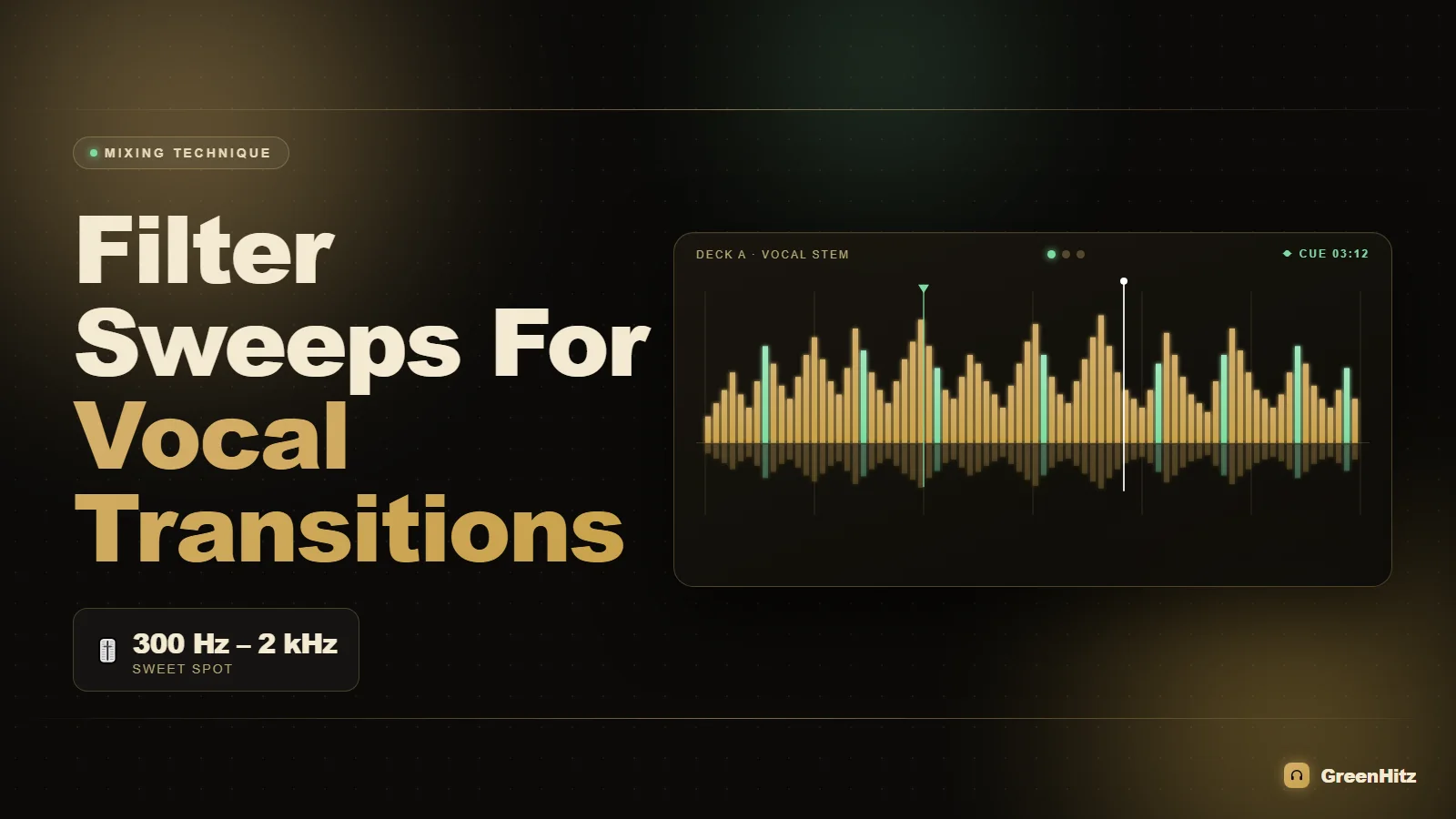
To use filter sweeps for smooth transitions between vocal heavy tracks, roll the high-pass filter up on the outgoing track to thin it out while the incoming track builds, so only one lead vocal ever sits front and center. Time the sweep to a phrase boundary (usually an 8 or 16 bar mark), pull the low end out of the track you are leaving, and let the fresh vocal take the space. The filter is doing the work your EQ alone cannot: it clears frequency room and hides the moment two voices would otherwise collide.
Vocal tracks are the hardest thing in the world to blend. A cappella-heavy pop, R&B, hip hop and afro records all carry a lead vocal that grabs attention instantly, and the human ear will notice two competing voices before it notices anything else in the mix. Beatmatching is the easy part. Making the transition feel intentional instead of accidental is where the filter earns its keep.
Why vocal-on-vocal transitions go wrong
When you crossfade two full vocal tracks, three things happen at once. The lyrics clash and the brain cannot lock onto either one. The midrange stacks up because both voices live in roughly the same 200 Hz to 4 kHz band. And the low end doubles, which is the same muddy pileup you get when you blend two basslines. If your blends already sound thick and undefined, my breakdown of why DJ transitions sound muddy when you blend basslines covers the low-frequency side of this in detail.
A filter sweep solves the problem by carving frequency space in real time. Instead of two full-range tracks slugging it out, you shrink one of them down to a thin, high, atmospheric layer that sits above the incoming record. The listener still hears continuity, but there is only ever one dominant voice.
High-pass vs low-pass: which sweep does what
Both filters have a place in vocal transitions, and they do opposite jobs. Knowing which one to grab in the moment is half the battle.
| Filter | What it does | Best use in a vocal transition |
|---|---|---|
| High-pass (HPF) | Removes low frequencies as you turn it up, leaving a thin, airy top end | Thinning out the OUTGOING vocal track so the new lead can breathe |
| Low-pass (LPF) | Removes high frequencies as you turn it up, leaving a muffled low rumble | Bringing in the INCOMING track from underneath, then opening it up |
Most club mixers (Pioneer DJM, Allen & Heath Xone, Rane) use a single knob per channel: center is off, turn left for low-pass, turn right for high-pass. On a DJM the color FX filter behaves the same way. Get comfortable feeling for that dead-center detent without looking, because you will be riding it by ear.
How to use filter sweeps for smooth transitions, step by step
Here is the workflow I run for a clean vocal-to-vocal blend. This assumes both tracks are beatmatched and phrase-aligned. If your phrasing is off, everything below falls apart, so nail the alignment first.
- Find your entry point. Cue the incoming track to the start of a clean instrumental or a short vocal chop, ideally an intro without a competing lead line. Clean intro versions make this a thousand times easier, which is one reason I lean on clean edits and intro versions for DJ sets.
- Start the sweep on the outgoing track. As the incoming track drops in, slowly turn the high-pass filter up on the track that is leaving. Around 300 to 500 Hz you will hear the body of the vocal thin out. This is where the two voices stop fighting.
- Pull the bass with EQ. Don't rely on the filter alone for the low end. Cut the outgoing channel's bass EQ to zero so the incoming kick and bass own the bottom cleanly.
- Ride the sweep to the phrase mark. Take a full 8 or 16 bars to move the filter. Fast sweeps read as effects; slow sweeps read as musical transitions. Land the top of your sweep exactly on a downbeat.
- Cut or fade the outgoing track. Once the filter is high enough that only a whisper of top end remains, pull the fader down on the downbeat. The new vocal is already established, so the exit is invisible.
The reverse move works too. Bring the incoming track in under a low-pass filter so it sounds muffled and distant, then open the filter as the outgoing track fades. This is great when the incoming record has a strong vocal from bar one and you want to preview it without committing.
Timing the sweep to the phrasing, not the clock
The single biggest mistake is treating a filter sweep as a fixed-length effect. It is not. A sweep should breathe with the music. If the vocal phrase resolves at the end of a 16-bar section, that resolution is your target: the filter should hit its peak right as the old vocal finishes a line, not in the middle of a word. Cutting a track mid-syllable is the audible equivalent of tripping on stage.
Set cue points at the start of vocal sections so you always know where the phrasing lands. A tight marker system makes this automatic under pressure, and I break down my full setup in the guide to the best cue point setup for live DJ sets. When you can see exactly where the next vocal enters, you can time the sweep to duck out just before it arrives.
Key matters more than you think
Even a perfect filter sweep sounds wrong if the two vocals are in clashing keys. During the overlap where both voices are audible, dissonant keys create tension that no amount of filtering hides. Keep your transitions to compatible keys using the Camelot system, and the overlap will sound harmonically sweet instead of sour. If you are new to this, start with the fundamentals of mixing harmonically using the Camelot wheel, then apply it specifically to layered vocals with my notes on layering acapellas over instrumentals without clashing keys.
Filter sweep plus effects: the pro-level combo
The filter is your foundation, but it plays well with two other tools for vocal work.
Reverb tail on the exit
As you sweep the high-pass up and pull the fader, feed a touch of reverb into the outgoing channel. The thinned-out vocal dissolves into a wash instead of just disappearing. It sounds deliberate and cinematic, especially on emotional R&B or slower pop.
Echo out for a hard exit
When the outgoing vocal has one killer last line, a filtered echo out can be the mic-drop moment. Throw the echo on the final phrase, sweep the filter up underneath it, and let the repeats trail off into the incoming track. My full method for this lives in the guide to echo out transitions on CDJs.
Loop roll to build a runway
If the incoming track has a short intro and you need more room to work the filter, a loop roll buys you bars without a jarring restart. Pair it with the sweep and you get a long, controlled build. See using loop rolls to extend short intros for the mechanics.
Gear and settings that make sweeps sound good
Not all filters are created equal. Some mixers have a resonance or "filter feel" control that adds a whistling peak at the cutoff frequency. A little resonance adds character on a build; too much turns your vocal into a screaming kettle. Start conservative.
- Resonance: Keep it low for vocal transitions. You want smooth removal of frequencies, not a squealing peak that draws attention.
- Sweep range: On most digital mixers the high-pass tops out well above where the vocal lives, so you rarely need to max it out. The 300 Hz to 2 kHz range is where the magic happens for voices.
- Monitor in headphones: Sweep the cued track in your cans first so you know where the vocal thins out before you do it live. Good isolation matters here, which is why I rate a solid pair of DJ headphones for loud clubs.
One more foundational point: gain staging. If your channels are hot and clipping, the filter will just make distorted vocals sound thinner and more distorted. Get your levels right first with the basics of setting gain staging correctly.
Pulling the right versions from your pool
Clean, DJ-ready files make filter sweeps effortless. Intro edits, instrumentals and acappellas give you material with space built in, so you are not fighting a full arrangement every time. Building a library of those versions is exactly what a record pool like GreenHitz is for: you grab the intro version and the acappella of the same track, then decide in the moment which one lets the filter do its job. For more mixing breakdowns like this one, the full library of DJ guides goes deep on transitions, harmonic mixing and set building.
Frequently Asked Questions
What frequency should I set my high-pass filter for a vocal transition?
Start your sweep around 300 to 500 Hz to thin the body of the outgoing vocal, and push toward 1.5 to 2 kHz if you want almost nothing but air left. The exact spot depends on the singer's range, so preview it in your headphones first and stop the sweep where the two voices stop clashing.
How long should a filter sweep transition take?
Match it to the phrasing, not a stopwatch. Most vocal transitions work over 8 or 16 bars, which is roughly 15 to 30 seconds at 120 to 128 BPM. Faster sweeps read as effects, slower sweeps read as musical blends. Always land the peak of the sweep on a downbeat.
Should I use the channel filter or an FX filter for sweeps?
The dedicated channel filter (the color knob on a DJM or the per-channel filter on a Xone) is best because it stays out of your effect send and never adds unwanted delay or reverb. Use FX filters only when you specifically want the combined character, like a filtered echo on an exit.
Can I use filter sweeps to mix two full acappellas together?
Rarely, and only briefly. Two lead vocals will always compete, so a filter helps but cannot fully hide the clash. It is better to layer one acappella over an instrumental. If you must blend two vocal tracks, keep the overlap short and use the filter to make the exit fast and clean.
Why does my vocal sound weak after I filter it?
That is the filter working, but if it sounds thin and lifeless rather than airy, you have probably pushed the high-pass too far or your gain was low to begin with. Back the cutoff down a touch and check your levels. A little reverb on the filtered signal restores a sense of size without the low end.
Do filter sweeps work for genres other than pop and R&B?
Absolutely. Filter sweeps are genre-agnostic and shine anywhere vocals dominate: afrobeats, amapiano, hip hop, dancehall and vocal house all benefit. The timing shifts with the groove, but the core move (thin the outgoing vocal, protect the incoming lead) stays exactly the same.


