
How to Beat Juggle Two Copies of the Same Track on CDJs
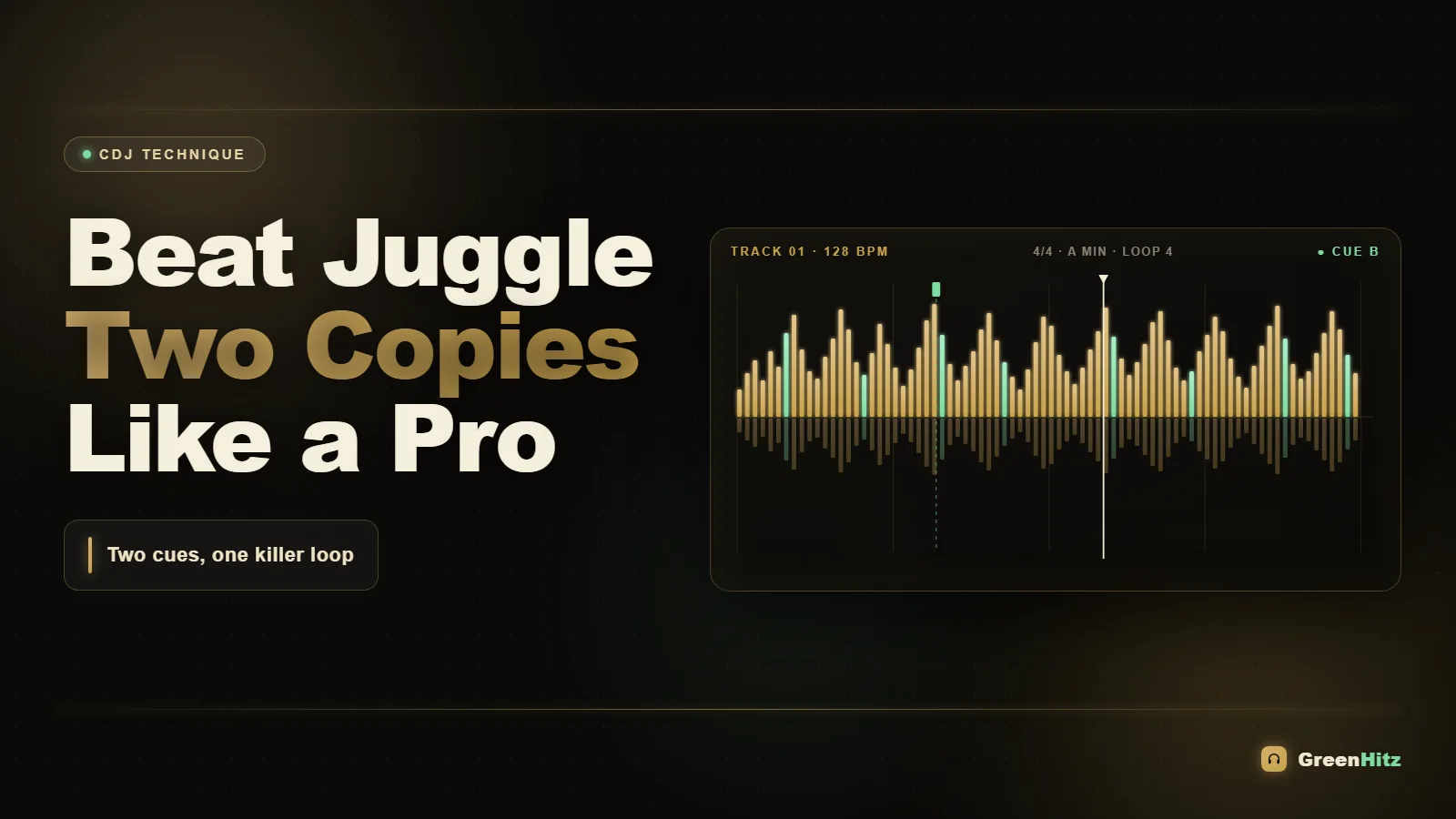
To beat juggle two copies of the same track on CDJs, load the identical file onto both decks, set matching hot cues on the same beats (usually the kick and snare of a drum section), then trade back and forth between the decks by pressing a cue on Deck A while the other copy sits paused on the same point. You are manually rearranging the drums live by jumping between two synced copies, creating a loop or fill that does not exist in the original. Get both copies phrase-locked, use quantize while you learn, and start with a simple two-cue pattern before you chase anything fancy.
That is the whole trick in one paragraph. Now let us break down the gear, the cue points, and the muscle memory that make it actually sound good in a room instead of like two songs fighting each other.
What Beat Juggling Actually Is (And Why It Still Matters on CDJs)
Beat juggling came from turntablists cutting between two vinyl copies of the same break to extend it, flip it, and build new drum patterns in real time. On CDJs you get the same result without needing perfect platter control, because the players do the hard part: they let you drop precisely on a cue point every single time. That is a gift for beginners. The DJ still has to hear the phrasing and hit the button in time, but you are not fighting a warped record.
Why bother when you could just loop a section? Because a juggle sounds alive. Looping repeats the exact same bar. Juggling lets you skip a hit, double a kick, throw in a snare early, and reshape the groove on the fly. It reads as a real performance moment to a crowd, which is why it wakes a room up during a build or a beat breakdown far better than a static loop.
Gear You Need: CDJs, a Mixer, and Two Identical Files
You do not need the flagship gear. Any pair of players with hot cues and quantize works: CDJ-2000NXS2, CDJ-3000, XDJ-1000, or even an all-in-one like the XDJ-RX3. The requirements are simple:
- Two copies of the same track loaded on two decks (or two layers on a controller).
- Hot cue buttons you can hit fast and comfortably.
- Quantize, which snaps your cue drops to the grid so early presses still land on the beat.
- A clean crossfader or channel faders you can cut between quickly.
If you are running Rekordbox or Serato off USB, you can literally load the same file to both decks from one library entry. On a laptop controller like the FLX4 it is even easier; if that is your setup, our guide on how to use a DDJ FLX4 to prepare and play record pool tracks walks through the layer and cue workflow. And make sure both copies are the same version and bitrate, because a radio edit and an extended mix have different arrangements and will not line up. Pulling clean, DJ-ready versions from a pool like GreenHitz keeps your two copies genuinely identical, grid and all.
Setting Your Cue Points: The Foundation of a Clean Juggle
Everything lives or dies on your cue placement. If your two copies have cues on different beats, the juggle will sound sloppy no matter how good your timing is.
Pick a strong, simple drum section
Find a spot in the track with a clear kick and snare and not much melodic clutter, usually an intro, a breakdown, or a drum-only bar. Isolated drums juggle cleanly. Busy sections with sustained pads or vocals smear when you cut between copies.
Set matching cues on the same beats on both decks
Set Hot Cue A on the downbeat (the 1). Set Hot Cue B on the snare (the 3, in most 4/4 dance and hip hop). Now copy those exact cues to the second deck. In Rekordbox and Serato your saved hot cues travel with the file, so if you prep once, both copies load with identical cues. That prep-once approach is the same discipline covered in our piece on the best cue point setup for live DJ sets.
Turn quantize ON while you learn
Quantize is training wheels you do not need to feel bad about. With it on, your cue drops snap to the nearest beat or bar, so a press that is a hair early or late still lands in time. Set the quantize value to 1 beat at first. As your timing sharpens, drop it to 1/2 or 1/4 beat for tighter, more expressive juggles.
The Basic Two-Deck Juggle, Step by Step
Here is the simplest juggle that sounds good immediately: trading the same beat back and forth to extend a drum section.
- Load the identical track on Deck A and Deck B. Beatmatch them so the tempos and grids line up (if the files are identical, the BPM is already the same; just phrase-align).
- Set the crossfader fully to Deck A. Play Deck A.
- On Deck B, pause it parked on Hot Cue A (the downbeat), ready to fire.
- Right before the drum loop you want ends, cut the crossfader to Deck B and press Hot Cue A. Deck B now plays from the 1.
- Immediately re-cue Deck A back to its Hot Cue A, ready to fire.
- Cut back to Deck A on the next downbeat and press its cue. Repeat.
What you are doing is looping one bar by hand, jumping between two copies so each deck resets while the other plays. Once that feels natural, start using different cues on each deck (kick on one, snare on the other) to build patterns instead of just repeating a bar.
Building Patterns: Trading Kicks and Snares
The fun starts when you stop copying the same bar and start rearranging it. A classic beginner pattern:
- Deck A plays the downbeat (kick).
- Cut to Deck B on the snare cue, throwing an extra snare in early.
- Cut back to Deck A for the next kick.
- Cut to Deck B again for a stutter (double-tap the snare cue with quantize on 1/4).
Count out loud while you practice: "one, cut, three, cut." Your ears and your hands need to agree on where the beat is. This is the same phrasing awareness that makes hot-cue remixing work, and if you want to push into full live edits, our guide on using hot cues to create live remixes from record pool edits is the natural next step after you own the basic juggle.
Common Beginner Mistakes and How to Fix Them
| Problem | Cause | Fix |
|---|---|---|
| Juggle sounds off-beat | Cues not on matching beats, or quantize off | Reset both cues to the same beat, turn quantize on at 1 beat |
| Volume jumps between cuts | Deck gains or channel faders not matched | Match trims and keep both channel faders at the same level |
| Audible "click" on each cut | Cutting mid-note on sustained sounds | Juggle over isolated drums, not pads or vocals |
| One deck drifts out of time | Not re-cueing fast enough after each hit | Re-cue the instant you cut away; make it a reflex |
| Muddy low end during the juggle | Both copies bleeding bass at once | Hard-cut with the crossfader so only one deck sounds at a time |
That last one matters more than beginners expect. If you soft-blend two copies of the same bassline, the low end turns to mush. Cut hard so only one deck is audible at any moment. If muddy low end is a recurring headache in your sets generally, our breakdown of why DJ transitions sound muddy when you blend two basslines digs into the frequency side of it.
A Practice Routine That Builds Real Muscle Memory
Beat juggling is a physical skill, so treat it like one. Fifteen focused minutes a day beats two rushed hours a week.
- Week 1: One track, quantize on 1 beat, just trade the downbeat back and forth for eight bars without drifting.
- Week 2: Add the snare cue. Trade kick and snare in a simple two-cue pattern.
- Week 3: Drop quantize to 1/2 beat. Add stutters and early snares.
- Week 4: Turn quantize off on one deck and juggle by feel over an isolated break.
Record every session and listen back. Your ears will catch timing slips your hands did not feel in the moment. This is also where solid waveform alignment on CDJs pays off, because reading the waveform tells you exactly where your cut landed relative to the grid.
Where to Drop a Juggle in a Real Set
A juggle is a spice, not the main dish. Use it during a breakdown to build tension before a drop, to extend a hot drum section the crowd is already loving, or to transition out of an acappella-heavy moment into pure rhythm. In a hip hop set it shines over classic breaks; in house it works over drum-driven tool tracks. Do not juggle every track or it stops feeling special. Pick one or two moments a set, land them clean, and let the crowd feel the difference. For more hands-on CDJ techniques, browse the rest of our DJ guides.
Frequently Asked Questions
Do I need two copies of the same file to beat juggle on CDJs?
Yes, classic juggling uses two identical copies so you can jump between them while each resets. On modern CDJs and controllers you load the same file to both decks. Make sure both are the exact same version and bitrate, otherwise the arrangements and grids will not line up and the juggle will sound off.
What BPM range is easiest for beginners to beat juggle?
Start slower, around 85 to 100 BPM, which is why hip hop and boom-bap breaks are ideal first material. The slower tempo gives you more time between hits to re-cue the other deck. Once your reflexes sharpen, move up to house and techno in the 120 to 130 BPM range.
Should quantize be on or off when beat juggling?
Turn quantize on while you learn. It snaps your cue drops to the grid so slightly early or late presses still land in time. Start at 1 beat, then tighten to 1/2 or 1/4 beat as you improve. Advanced juggling with quantize off gives more expressive, off-grid patterns, but that comes later.
Can I beat juggle on a controller instead of CDJs?
Absolutely. Any controller with hot cues and quantize works, from a DDJ-FLX4 to an SRT. The workflow is identical: load the same track to both layers or decks, set matching cues, and trade between them. The only real requirement is responsive hot cue pads and a crossfader you can cut cleanly.
How do I stop my beat juggle from sounding muddy?
Hard-cut with the crossfader so only one copy plays at a time, never blend two copies of the same bassline together. Match your deck gains and channel faders so there are no volume jumps, and juggle over isolated drum sections rather than parts with sustained pads or vocals that smear when cut.
How long does it take to get good at beat juggling?
With focused daily practice you can land a clean two-cue juggle in a couple of weeks. Sounding natural and doing it live under pressure takes a couple of months. The key is short daily reps with quantize on, recording yourself, and gradually tightening the quantize value as your timing locks in.


