
How to Beatmatch Faster Using Waveform Alignment on CDJs
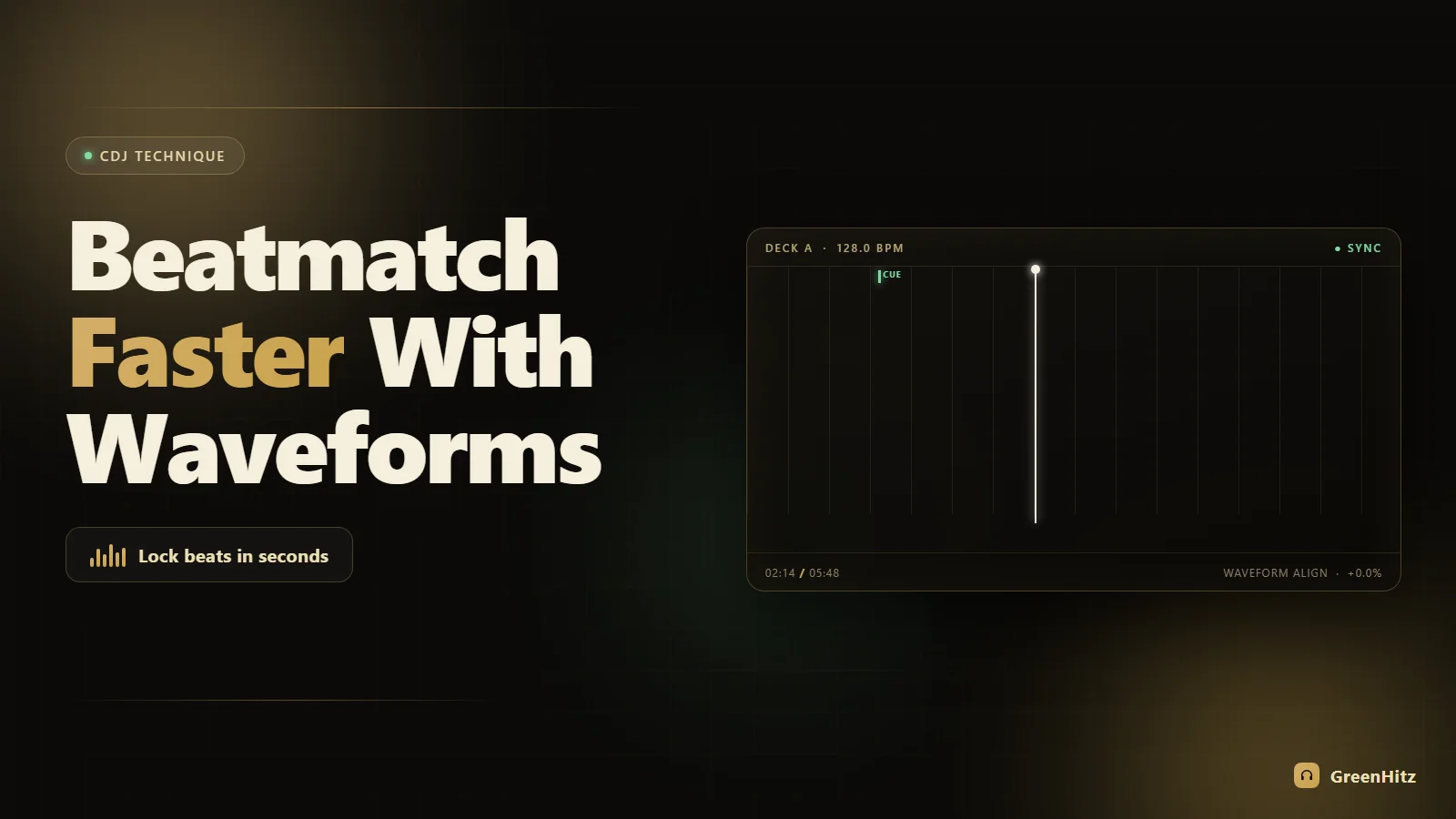
To beatmatch using waveforms on CDJs, match the tempos with the BPM readout first, then line up the tall transient spikes (the kick and snare peaks) of your incoming track with the peaks of the track playing, watching the phase meter until the two lines sit dead center. Use the jog wheel for tiny nudges and the tempo fader for drift. The waveform tells you exactly where the beat lands, so you can align by eye in a few seconds instead of hunting purely by ear.
That is the short version. Now let me show you how to actually do it fast under club pressure, what to look at, what to ignore, and where waveform beatmatching quietly lies to you.
Why waveform alignment is faster than ear-only beatmatching on CDJs
Ear beatmatching is a skill every DJ should own, and I still think you should learn it first. But on a pair of Pioneer CDJ-2000NXS2, CDJ-3000, or the entry-level CDJ/XDJ units, the screen gives you a visual head start that vinyl DJs never had. The colored waveform shows you where energy lives: kicks and snares punch up as tall spikes, hi-hats and vocals fill in as thinner texture.
When you can see two sets of peaks side by side (or stacked, if you turn on the vertical waveform view), you are not guessing where the one is. You are matching a picture. Combine that with the phase meter and the beat grid markers, and you cut your beatmatch time down dramatically. That said, the waveform is a shortcut, not a replacement for your ears. The screen gets you 90 percent aligned; your ears close the last 10 percent. If you want the full ear-training foundation first, read our guide to beatmatching by ear step by step and then come back to layer the visual skill on top.
Setting up your CDJ display for fast waveform beatmatching
Before you can align anything, get the screen showing you useful information. On CDJ-2000NXS2 and CDJ-3000 units, dial these in:
- Enable the phase meter. This is the row of segments at the top of the waveform that shows how far ahead or behind your incoming beat is. Dead center means locked. It is the single most useful visual on the deck.
- Turn on the beat grid / beat count. Properly analyzed tracks show grid markers on the waveform. These only work if the track was gridded correctly during prep, which is where clean files matter.
- Use the enlarged waveform (the top waveform). It zooms as the track plays so you can see individual transients, not just the overview.
- Consider the vertical stacked waveform view on CDJ-3000, which puts both decks side by side so you can compare peaks directly.
Half of fast waveform beatmatching happens before the gig. If your tracks are analyzed with accurate BPM and clean beat grids, the CDJ does most of the heavy lifting. Sloppy grids send you chasing ghosts. This is why your prep workflow matters so much, and why pulling properly tagged, DJ-ready files from a pool like GreenHitz saves you from fighting bad analysis in the booth.
The step-by-step waveform beatmatch workflow
Here is the sequence I run on every blend, once the tempos are in range.
- Match the BPM. Read both BPM numbers. Move your incoming tempo fader until the numbers agree (or use Master Tempo / sync as a safety net if your setup allows, though we will get to sync later).
- Find the downbeat. Cue your incoming track to the first strong kick of a phrase. Set a cue point there so you can retrigger cleanly.
- Launch on the beat. Drop the incoming track roughly on a kick of the outgoing track. Do not obsess over perfection at launch; you will correct it.
- Read the phase meter. If the meter shows your incoming track ahead, you are early. Behind, you are late. Nudge accordingly.
- Nudge with the jog, correct drift with the fader. Touch the jog outer ring (in vinyl mode) or use the platter edge to shove the beat forward or back a hair. If the tracks keep drifting apart, the tempo is slightly off, so trim the fader.
- Confirm with your ears. Once the waveform peaks stack and the phase meter sits center, listen. Waveforms can look aligned while the swing feels off. Trust your ears for the final lock.
Reading transients: what the peaks actually tell you
The tall spikes are your beatmatch anchors. In a four-on-the-floor house or techno track, you will see evenly spaced kick spikes, one per beat. Line those up and you are close. In genres with syncopation like Afrobeats, amapiano, or hip-hop, the peaks are less uniform, so you match the strongest recurring hit (usually the kick or snare backbeat) rather than trying to align every bump.
Color coding helps too. On Pioneer's RGB waveforms, blue is low frequency (kick, bass), green is mids (vocals, synths), and white/red is highs (hats, cymbals). Match the blue peaks and your low end is aligned, which is what prevents that ugly bass flam when two kicks fight each other. If you have ever had a muddy, doubled-up low end during a blend, misaligned kicks are usually why, and it also ties into how your levels stack. Get your gain right by reading our breakdown of why your DJ mix is clipping and how to set gain staging.
The phase meter is your best friend (and where it lies)
The phase meter deserves its own section because beginners either ignore it or over-trust it. When both tracks are analyzed correctly, the phase meter is gospel: center means beats are locked. But it only reflects the beat grid, not reality. If a track was gridded wrong (common with live drummers, older recordings, or tracks that speed up), the meter will happily tell you you are locked while the actual audio drifts.
The fix: use the phase meter to get instantly close, then verify against the outgoing track by ear for a couple of bars. If they hold, you are golden. If they slip, your grid is off and you go back to jog-and-fader manual mode. This blend of visual and aural is exactly why waveform DJs who also trained their ears are so hard to catch out.
Should you just use sync instead?
Honest answer: sync is a tool, not a sin. On CDJs linked over Pro DJ Link, sync will beat-lock two analyzed tracks instantly. Plenty of working pros use it to free their hands for effects, loops, and reading the room. But sync inherits every flaw in your beat grids, so a badly gridded track will sync to the wrong place and sound worse than a manual match.
My take: learn waveform beatmatching and ear beatmatching cold, then use sync as a convenience when the tracks are clean and you want your attention elsewhere. If you lean on sync without the underlying skill, one bad grid or one gig on unlinked decks will expose you. Waveform alignment is the middle ground that keeps you fast and in control.
Prep work that makes waveform beatmatching effortless
The single biggest speed boost happens at home, not in the booth. Tracks with accurate BPM, tight grids, and set cue points let you launch on the downbeat every time. Build the habit covered in our guide to preparing tracks for DJing with gain, cue points and loops done right, and your waveform matches go from a scramble to a formality.
| Prep task | Why it speeds up waveform beatmatching |
|---|---|
| Accurate BPM analysis | Tempo faders start closer, less drift to chase |
| Corrected beat grids | Phase meter and grid markers actually tell the truth |
| Hot cue on the first downbeat | Launch on the one every time, no fishing |
| Clean intro edits | More bars of beats to align before vocals or drops hit |
| Consistent gain / loudness | Peaks look comparable, no volume-driven guesswork |
Clean intro versions matter more than people think. A long, beat-driven intro gives you a wide window of clear transients to align against before anything melodic complicates the picture. That is one more reason clean edits and intro versions are better for DJ sets. And once your tracks are gridded and tagged, keep them findable with a solid record pool workflow so you are not digging mid-set.
Common waveform beatmatching mistakes to avoid
- Matching hats instead of kicks. Align the low-frequency (blue) peaks first. Hats are too dense and will fool you.
- Over-nudging. Tiny touches. If you shove the jog hard, you overshoot and start rocking back and forth. Small corrections, then let it ride.
- Ignoring drift. If aligned beats slowly separate, the tempo is off by a fraction. Trim the fader, do not keep nudging.
- Trusting a bad grid. If the phase meter says locked but your ears say no, believe your ears.
- Only using the overview waveform. Watch the zoomed enlarged waveform for real transient detail.
Frequently Asked Questions
Can you beatmatch on CDJs without sync?
Yes, and you should be able to. Match the BPM with the tempo fader, launch your incoming track on the downbeat, then align the kick peaks on the waveform while watching the phase meter. Use the jog wheel for micro-nudges and trim the fader to kill drift. Waveform alignment plus your ears gets you locked in seconds.
What is the phase meter on a CDJ?
The phase meter is the row of segments above the waveform showing how far ahead or behind your incoming beat is relative to the master track's beat grid. Dead center means the beats are aligned. It is the fastest visual reference for beatmatching, but it only reflects the analyzed grid, so verify by ear if a track was gridded incorrectly.
Why do my beats drift apart after I match them?
Drift means the tempos are not exactly equal. Even a 0.1 BPM difference will slowly pull the tracks apart. Nudging fixes the position momentarily but not the cause. Correct it by trimming the tempo fader a hair in the direction that closes the gap, then re-align once and it should hold.
Do I match the tall spikes or the whole waveform?
Match the tall transient spikes, specifically the low-frequency kick peaks shown in blue on Pioneer RGB waveforms. Those are your beat anchors. The dense middle texture (hats, vocals, synths) is noise for beatmatching purposes and will mislead you. Lock the kicks and the rest falls into place.
Does waveform beatmatching work on tracks with live drums?
Partly. Live-recorded tracks often have inconsistent tempo, so their beat grids drift and the phase meter becomes unreliable. Use the waveform to get close, then switch to full manual jog-and-fader control and ride it by ear. This is where ear beatmatching training pays off and pure sync fails.
Is beatmatching by waveform cheating?
No. Reading the screen is just using the tools in front of you, the same way vinyl DJs read the label or a marker dot. You still control tempo, phase, and the blend by hand. Cheating would be leaning on sync with zero underlying skill. Waveform alignment is a legitimate, faster technique that top pros use every night.


