
Beatmatching by Ear: A Step-by-Step Guide for Beginners
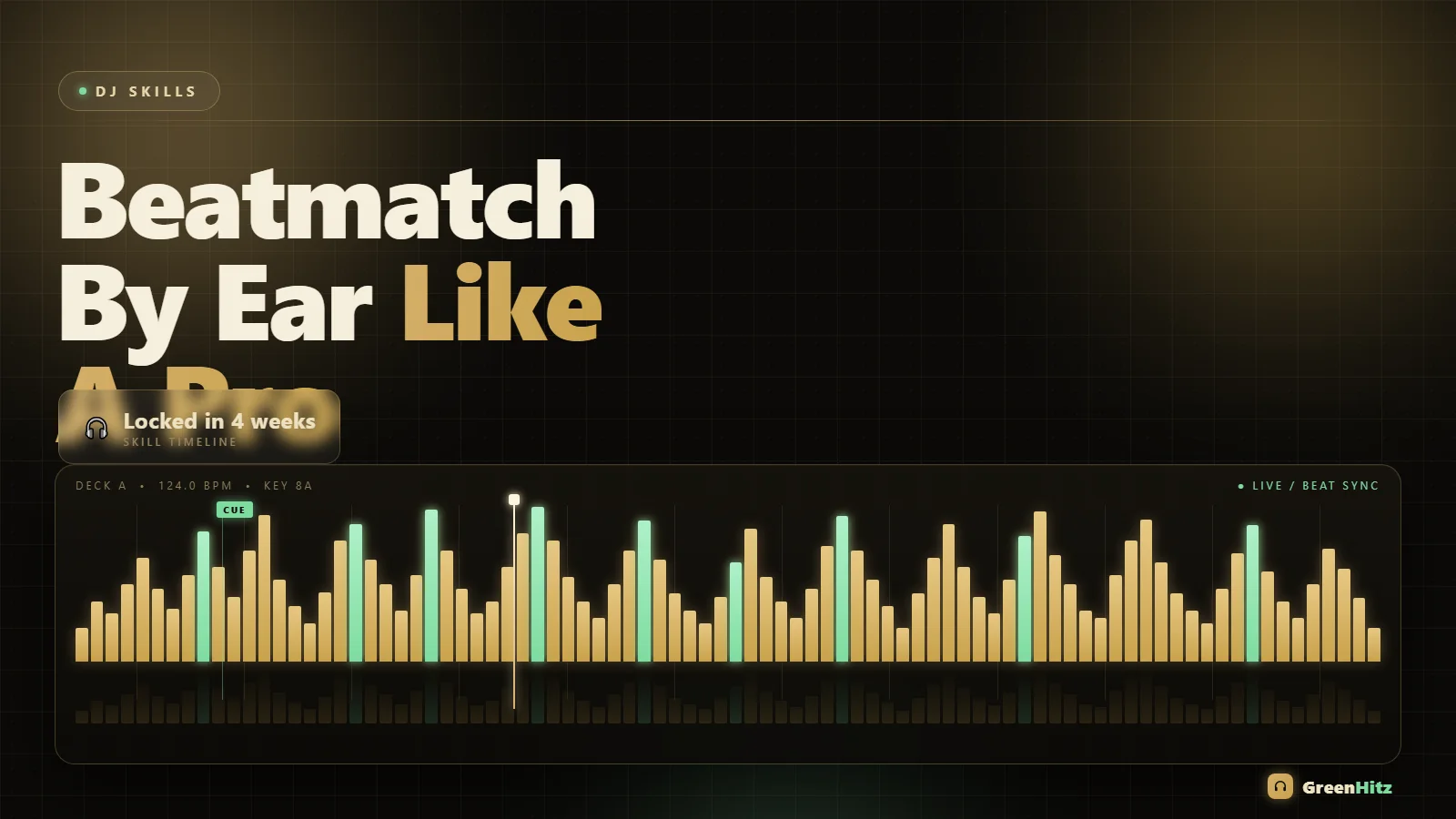
To beatmatch by ear, play your incoming track in your headphones, match its tempo to the track already playing by adjusting the pitch fader, then use the platter or jog wheel to nudge the beats until the kick drums land on top of each other. Once the two are locked, you drop the new track on the first beat of a phrase and ride the pitch fader to keep them tight. That is the whole game, and everything below is just detail, drills, and troubleshooting to get you there.
Yes, every controller and CDJ made in the last decade has a sync button. Use it when you need to. But learning to beatmatch manually teaches you to actually hear tempo and phrasing, and that skill makes you a better DJ on every deck, in every situation, even when the software glares wrong or the BPM reader chokes on a live drummer edit. Let's get into it.
What beatmatching actually means
Beatmatching is the act of getting two tracks playing at the exact same tempo, with their beats aligned, so they sound like one continuous groove. Two things have to be true at once:
- Same tempo: both tracks running at the identical BPM (beats per minute) so they don't drift apart.
- Aligned beats: the kick drums, snares, and hi-hats landing in the same place in time (phase), not offset.
Getting the tempo right but the phase wrong gives you a flam, a sloppy double-kick sound. Getting phase right but tempo wrong means they align for a second, then slide apart. You need both, and you hold both by ear.
Set up your gear before you touch the pitch fader
You cannot beatmatch if you can't hear the incoming track privately. Two things must be configured:
- Headphone cue: route the deck you are cueing (the one nobody hears yet) into your headphones only. On a mixer this is the CUE or PFL button on the channel. On a controller it is the same. Get one ear on the cued track and, ideally, one ear or the master speaker on the live track.
- Cue split or the classic one-ear technique: many mixers have a split-cue mode that puts the cued track in one side of your headphones and the master in the other. If you don't have it, use the old-school move: one headphone cup on, one ear open to the speakers.
Set your headphone volume loud enough to hear transients clearly. If you can't hear the kick attack, you can't line it up.
How to beatmatch step by step
Step 1: Find the tempo of the playing track
You need a reference. Look at the BPM readout if you're on a CDJ or controller, or count it: tap along to the kick and count the beats over 15 seconds, then multiply by four. Most club music sits in predictable ranges (house 120-128, hip-hop 85-100, drum and bass 170-175). Knowing the ballpark speeds everything up. If you rely on solid metadata, a pool that tags files properly helps: here is a rundown of the best DJ pool with BPM and key data so your library reads clean before you ever hit play.
Step 2: Rough-match the pitch
Cue your incoming track, start it playing in your headphones, and move its pitch fader until the two tempos sound close. If the readouts are visible, get the BPM numbers within one or two of each other first. Trust the numbers to get in the neighborhood, then trust your ears to finish the job. Do not skip the ear part. Displayed BPM lies more than you'd think, especially on edits and live recordings.
Step 3: Drop it in and find the drift
Start the incoming track on a downbeat so its "one" lines up with the live track's "one." Now listen. One of three things happens:
- They stay together: congratulations, you're close. Small correction only.
- The cued track pulls ahead: it's too fast. Nudge the pitch down slightly.
- The cued track falls behind: it's too slow. Nudge the pitch up slightly.
The direction of drift tells you exactly which way to move the fader. This is the core feedback loop of beatmatching.
Step 4: Correct phase with the jog or platter
Tempo and phase are two separate corrections. When the beats are close in speed but slightly out of alignment, you fix the position without changing the speed. On vinyl or a CDJ platter, gently push the record forward to speed it up momentarily, or drag the edge to slow it down, just enough to slide the kick into place. On a jog-wheel controller, a light nudge on the outer wheel does the same. These are momentary pushes, not permanent pitch changes.
Step 5: Trim the pitch until the drift stops
Once they're phase-aligned, watch for drift again. If they slowly creep apart over eight bars, your tempos still aren't identical. Make a tiny pitch adjustment (a fraction of a percent) in the drift direction. Re-align phase if needed. Repeat until the two tracks hold together for a full 30 seconds without you touching anything. That's a locked beatmatch.
Train your ear: the drills that actually build the skill
Beatmatching is a listening skill before it's a hand skill. Do these:
- The kick-doubling drill: load two copies of the same track. Nudge one out of phase, then bring it back until the two kicks become one thick kick with no flam. This trains your ear on phase with zero tempo variable.
- The blind BPM guess: play random tracks and guess the BPM before checking. You'll get scarily accurate within a couple weeks.
- The eyes-closed mix: once you can do it looking at waveforms, cover the screen. Waveforms are a crutch. Your ears are the real instrument.
Beatmatching by ear on different gear
| Setup | Speed control | Phase control | Notes |
|---|---|---|---|
| Turntables (vinyl) | Pitch fader | Push/drag the record edge | Purest feel, hardest to master, most rewarding |
| CDJs / media players | Pitch fader | Jog platter or pitch bend buttons | Displayed BPM helps but still verify by ear |
| Controllers | Pitch/tempo fader | Jog wheel nudge | Jog resolution varies; cheaper units feel loose |
The muscle memory differs, but the listening is identical. If you're weighing formats, our take on vinyl versus digital DJing breaks down what actually matters for skill-building versus convenience.
Phrasing: the part beginners skip
A perfect beatmatch that starts on the wrong bar still sounds wrong. Dance music is built in phrases, usually 8, 16, or 32 bars. The energy resets at the top of each phrase. To mix musically, align the "one" of your incoming phrase with the "one" of an outgoing phrase, not just any random beat. Count in fours: 1-2-3-4, 2-2-3-4, up to 8, and let the drop or breakdown of one track meet the intro of the next. Tracks with clean, beat-heavy intros make this far easier, which is why so many DJs lean on edited versions. If you want to understand the tools that make this smoother, read up on intro edits built for DJs.
Common beatmatching mistakes and how to fix them
- Chasing the fader constantly: if you're making big corrections every few seconds, your base tempo is off. Stop, re-set the pitch properly, then make micro-adjustments only.
- Ignoring the drift direction: the way tracks pull apart tells you exactly which way to move. Listen for it instead of guessing.
- Mixing tracks that clash in key: beatmatched but out of key sounds tense and muddy. Learning basic harmonic mixing (Camelot wheel) cleans this up fast.
- Bad source files: low-quality rips, mislabeled BPMs, and messy intros make beatmatching harder than it needs to be. Pulling clean, DJ-ready versions from a proper pool like GreenHitz removes half the friction before you even start.
How long does it take to learn?
Give it two to four weeks of daily 30-minute sessions and manual beatmatching stops feeling like math and starts feeling like breathing. The first week is frustrating. The moment it clicks (usually when you stop staring at waveforms and start trusting the drift) it becomes second nature. Keep at it. Once you own this, everything else in DJing gets easier, from creative blends to save-the-set recoveries when the tech fails you. For more skills that separate working DJs from hobbyists, dig through the rest of our DJ guides.
Frequently Asked Questions
Is beatmatching by ear still worth learning in 2026?
Absolutely. Sync buttons handle most club situations, but they fail on live recordings, edits with tempo shifts, and gear with bad BPM detection. Beatmatching by ear also sharpens your sense of timing and phrasing, which makes every mix cleaner and every creative transition more confident, sync on or off.
How can I tell which track is too fast?
Listen to which one pulls ahead. If your cued track's kick starts landing before the live track's kick, it's running fast, so lower its pitch. If it falls behind, it's slow, so raise the pitch. The direction of the drift always points to the fix.
What BPM range is easiest to beatmatch for beginners?
Steady four-on-the-floor genres like house and tech house (roughly 120-128 BPM) are the friendliest starting point because the kick pattern is constant and predictable. Genres with syncopated or swung drums, like hip-hop or some Afrobeats, are harder to beatmatch by ear at first because the downbeat is less obvious.
Do I need turntables to learn beatmatching?
No. You can learn on any setup with a pitch fader and a jog or platter, including entry-level controllers. Turntables give the purest feel and best long-term feedback, but the listening skill transfers to every format. Learn the ears first and the hands adapt to whatever gear is in front of you.
Why do my tracks sound out of tune when I beatmatch?
Moving the pitch fader on most gear changes speed and pitch together, so large tempo changes shift the musical key. Keep pitch adjustments small, or enable key-lock (master tempo) to change speed without altering pitch. Mixing tracks in compatible keys also prevents the clashing, tense sound.
Should I use waveforms to help me beatmatch?
Waveforms are a useful reference when you start, but treat them as training wheels. Relying on them stops you from developing your ear, and they fail you the moment you play analog gear or a track with no visual sync. Practice covering the screen so your ears do the work.


