

How to Build a Two Hour Warm Up Set That Reads the Room
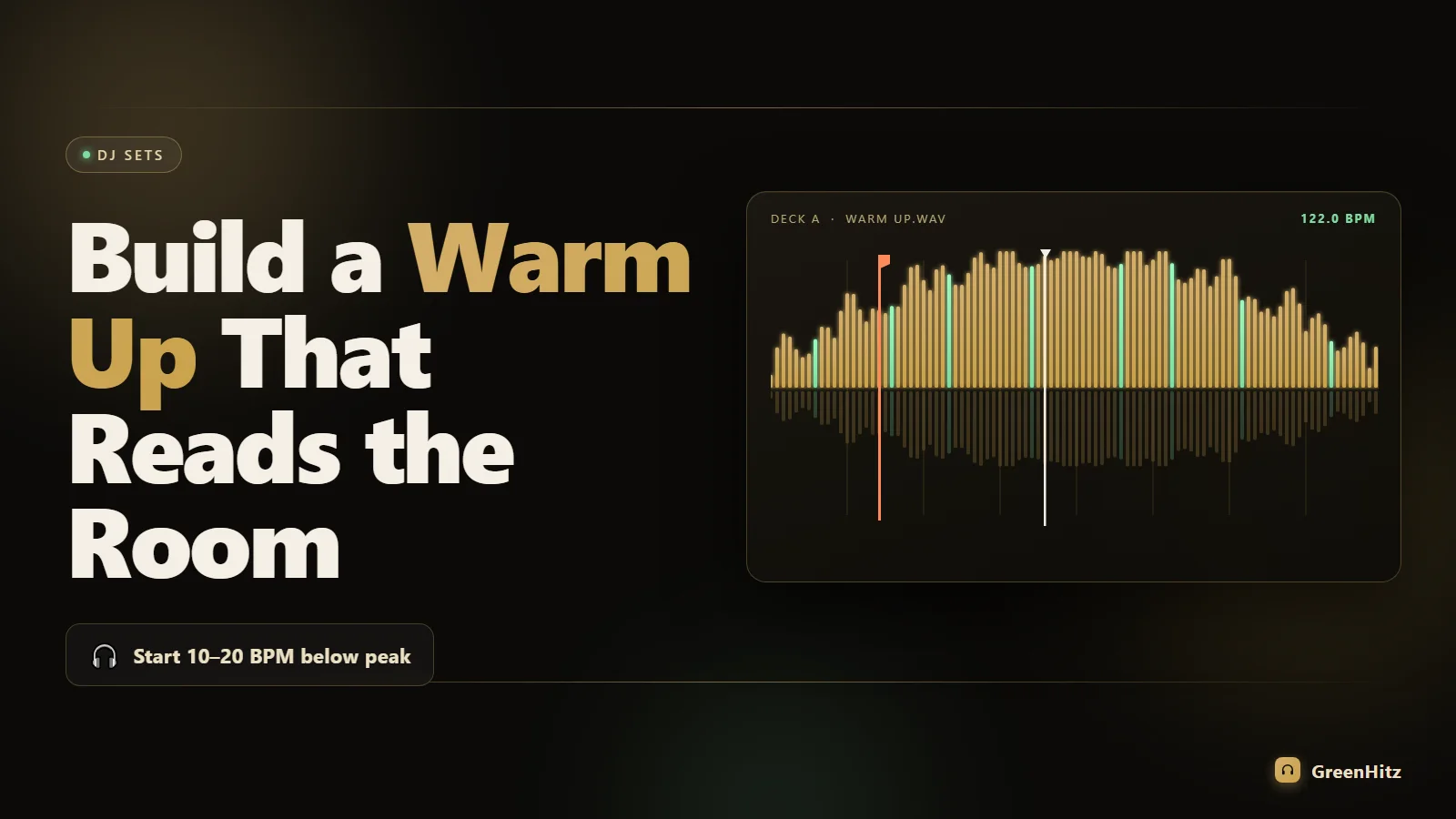
To build a warm up DJ set, start 10 to 20 BPM below peak time (think 118 to 122 for house), keep energy low and groovy for the first 45 minutes, then climb in small steps every 20 to 30 minutes so you hand the headliner a floor that is warm but not exhausted. Read the room by watching feet and body language instead of playing your favorites, and never peak before your slot ends. That restraint is the entire job.
The warm up is where a lot of DJs quietly kill their careers. They get a two hour opener, panic at an empty room, and drop the biggest record they own 40 minutes in. The floor pops for one song, then dies, and the headliner walks into a burned-out room with nowhere to go. Do that a few times and you stop getting booked. Do the opposite and promoters remember you as the person who makes their night work.
What a warm up set is actually for
Your job is not to be the star. Your job is to move the crowd from standing at the bar to loosely dancing, and to set a musical foundation the next DJ can build on. That means genre, energy and tempo all need to point toward where the night is going, not toward your personal highlight reel.
A good warm up does three things: it establishes a groove that feels good at low volume in a half-empty room, it slowly raises the temperature without any obvious peaks, and it ends about one notch below where the headliner will start. If the main act opens around 126 and drops vocals early, you want to be sitting around 122 to 124 with instrumental, hypnotic material by the time you pass the deck.
Know the night before you touch a track
Ask the promoter or the headliner two questions: what time does the room usually fill, and what does the peak sound like? A techno night wants a very different runway than an open format bar gig. If you do not know the destination, you cannot pace the trip. When you know the headliner plays driving tech house at 126, your two hours should be a slow on-ramp to exactly that.
The energy curve: mapping your two hours in blocks
Break the two hours into four 30-minute blocks. Each block has a job. Do not think in individual tracks yet, think in temperature.
| Block | Time | BPM range | Energy goal | Vocals |
|---|---|---|---|---|
| 1 | 0:00 to 0:30 | 116 to 120 | Atmosphere, groove, no pressure | Minimal or none |
| 2 | 0:30 to 1:00 | 120 to 122 | First dancers, deeper grooves | Light, hooky |
| 3 | 1:00 to 1:30 | 122 to 124 | Floor filling, more drive | Selective |
| 4 | 1:30 to 2:00 | 124 to 126 | Momentum, hand off warm | Pull back, go instrumental |
Notice the vocal column. Early on, big vocals feel like you are trying too hard in an empty room. As the floor fills, a hooky vocal can pull people in. Then near the handoff you strip vocals back out so the incoming DJ has room to introduce their own. If you want to master the vocal timing itself, our guide on using filter sweeps for smooth transitions between vocal tracks pairs well with this pacing.
Small tempo steps beat big jumps
Do not jump 6 BPM in one mix. Climb 1 to 2 BPM at a time and let three or four tracks live at each new tempo before you push again. The crowd should never consciously feel the set speeding up. They should just notice, 90 minutes in, that they are dancing harder than they realized. Pitch riding a couple of tracks up slowly is fine; abrupt tempo grabs are what make a floor feel jerked around.
Track selection: dig for grooves, not anthems
The single biggest mistake is stocking your warm up crate with peak-time weapons. You want the deep cuts, the dub mixes, the instrumental tools, the tracks with long percussive intros and a slow build. These are exactly the versions a record pool exists for. When I prep an opener I pull the extended and dub edits from GreenHitz specifically because they give me clean, DJ-ready intros with room to blend rather than radio edits that slam straight into a chorus.
Build your warm up crate around these categories:
- Groove foundations: percussive, rolling tracks with a strong but not aggressive bassline. Your block 1 and 2 backbone.
- Atmosphere: pads, dub chords, spacious mixes that make an empty room feel intentional instead of dead.
- Hooks with restraint: tracks with one memorable element (a vocal snippet, a riff) that reward a filling floor without exploding.
- Bridges: tempo-flexible tools that let you climb from one BPM zone to the next cleanly.
Keep the actual crowd-pleasers you love out of this set entirely. If a track would work at peak, it does not belong in your warm up. Save it. If you want the counterpoint to all this restraint, read how to prepare a one hour peak time club set from a record pool, because understanding where the peak lives tells you exactly how far below it to stay.
Organize the crate so you can react
You cannot read the room if you are staring at your screen scrolling. Set up playlists by energy and BPM zone before you leave the house so every track you might need is two taps away. I lay mine out in the same energy tiers as the table above. Our system for organizing DJ playlists by vibe for fast access is built exactly for this kind of on-the-fly reaction, and it is the difference between playing to the room and playing to your laptop.
How to actually read the room in real time
Reading the room is a skill, not a vibe. Here is what to watch, in order of reliability:
- Feet and hips. Heads nodding means nothing. When people shift weight foot to foot or their hips start moving, the groove is landing. Push a little.
- Movement toward the floor. If people are drifting from the bar toward the DJ, you are winning. If they are drifting away, you overshot.
- Density near the booth. The area closest to you fills first. Watch it fill or empty as a live meter.
- Phones down. When people stop checking phones, they are locked in. When phones come up, you either hit something great or lost them.
The rule: if the floor is responding, hold the energy where it is for another track or two before you climb. Do not reward a good response by immediately pushing harder. Let them settle into the win, then take the next small step.
When the room is dead at the start
Empty rooms are normal for warm up slots. Do not fight it. Play like the room is full and confident: solid grooves at a comfortable volume, no desperate energy grabs. An empty floor with a great groove playing tells people the night has taste. An empty floor with a DJ throwing bangers at nobody tells people to stay at the bar. Confidence in the quiet is what separates real openers from hobbyists.
Mixing technique for a warm up: long, clean, invisible
Warm up mixing should be nearly invisible. Long blends, full phrase matching, EQ swaps that nobody notices. This is not the slot for quick cuts and scratching. Let tracks breathe for 32 or 64 bars in the mix so the groove feels continuous. Tight phrasing is everything here; if you are shaky on counting, our breakdown of phrase matching using 8 and 16 bar counting will lock your blends in.
Keep your EQ discipline sharp. Because early tracks are sparser, muddy low-end mistakes are more obvious in a quiet room. Swap basslines cleanly, one out as the other comes in, and mind your gain so nothing jumps in loudness between records.
The handoff: end warm, not peaked
The last 15 minutes matter more than any other part of the set. You want to arrive at the handoff tempo, drop vocals, and finish on a track that grooves hard but leaves headroom. The incoming DJ should be able to mix in and immediately lift the energy. If you peaked at 1:45 and the crowd is spent, you did the opposite of your job.
Talk to the next DJ before your set ends. Ask what they want to open on, tempo and vibe. A 20-second conversation lets you land your last track on a runway they can take off from. That courtesy gets you rebooked faster than any technical skill.
Frequently Asked Questions
What BPM should I start a warm up set at?
Start 10 to 20 BPM below the night's peak tempo. For a house or tech house night peaking around 126 to 128, open around 116 to 120. For a bar or lounge warm up, you might start as low as 110 to 115. The exact number matters less than staying clearly below where the headliner will begin.
How long should tracks play in a warm up set?
Longer than you think. Let tracks run and blend over 32 to 64 bars so the groove feels continuous and hypnotic. Quick cuts and short mixes signal peak-time energy, which fights the slow-build job of an opener. Long, patient blends keep the room comfortable and let dancers settle in.
Should I play vocal tracks during the warm up?
Sparingly, and mostly in the middle blocks. Big vocals early feel forced in a quiet room, and heavy vocals right before the handoff steal the next DJ's runway. Use light, hooky vocal moments to pull people onto the floor once it starts filling, then pull back to instrumental grooves for the final stretch.
What do I do if the dance floor is empty during my set?
Play like the room is full. Hold confident grooves at a comfortable volume and resist dropping big records to force a reaction. An empty floor early is normal for an opener. A great groove in a quiet room signals a night with taste; desperate bangers to nobody signal the opposite and keep people at the bar.
How is a warm up set different from a peak time set?
A warm up builds slowly, stays below peak tempo, favors deep grooves and dub mixes, and ends one notch below where the main act starts. A peak time set delivers vocals, drops and maximum energy. The warm up creates the runway; the peak set takes off from it. Mixing them up burns the room out early.
How do I hand off smoothly to the next DJ?
Talk to them before your set ends and ask what tempo and vibe they want to open on. Land your final track at the handoff tempo, drop vocals, and finish on something that grooves but leaves energy headroom. That lets them mix in cleanly and lift the room instead of trying to rescue a floor you already peaked.


